
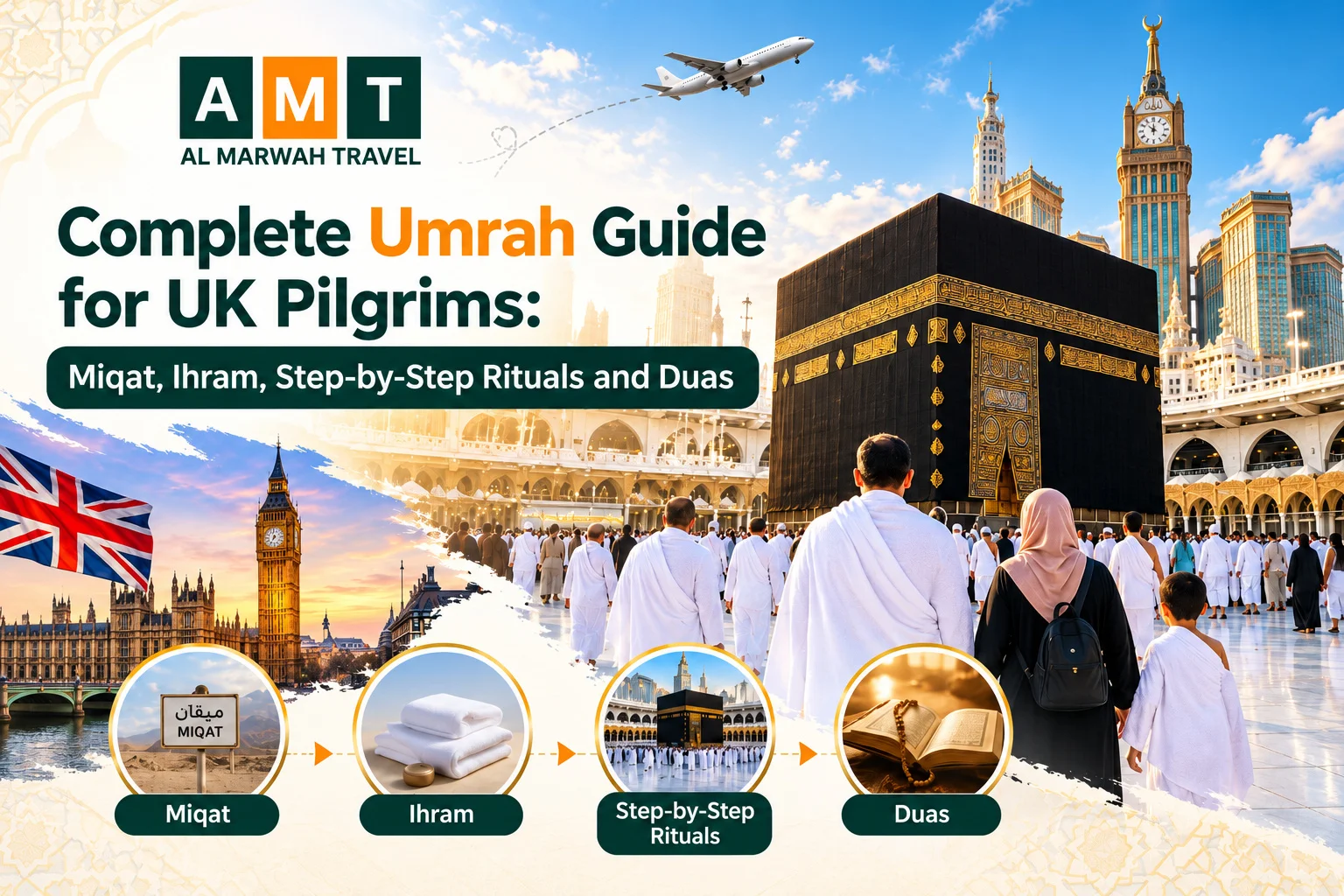
This complete Umrah guide for UK pilgrims walks you through every step before you fly, from preparing for Ihram and the Miqat to finishing with halq, with the duas and key rulings at each stage.
Step 1: Prepare and Put On Ihram
What to do:
- Trim your nails, remove underarm and pubic hair, use miswak, make wudu and take a full ghusl.
- Apply fragrance to your body and Ihram sheets (Sunnah) before the intention. Avoid scents that stain cloth.
- Men: wear two plain unsewn sheets, one for the waist and one for the shoulders. A pocket belt is allowed for your passport and money.
- Women: wear normal, modest sewn clothes. Socks and gloves are fine. Keep the head covered.
Men’s footwear:
- Wear open sandals or flip-flops that leave the raised middle part of the foot (the instep) uncovered.
- Put them on before you make the intention, because closed shoes are forbidden afterwards.
- Choose sandals you have already walked in.
Face covering:
- Nothing should touch the face, whether a veil, cloth, scarf or mask.
- Women may hold a handheld fan or book near the face for privacy, as long as it does not touch.
- For men, covering the nose or face with cloth is makruh (disliked).
Tips:
- Practise wearing Ihram at home.
- Choose thick cotton so skin colour is not visible.
- Keep your fragrance bottle out of your belt pocket.
Important: Ihram restrictions begin only after the intention and Talbiyah, not when you put the clothes on.
Step 2: Nafl Prayer of Ihram
- Pray two rakahs with the intention of Ihram.
- Avoid makruh prayer times, and men should keep their heads covered during this prayer.
- Recite Surah al-Kafirun in the first rakah and Surah al-Ikhlas in the second, after al-Fatihah.
Step 3: Miqat, Where You Must Make Your Intention
What is Miqat?
- Miqat is a fixed boundary around Makkah. A pilgrim heading to Makkah for Umrah must not cross it without Ihram.
- Wearing Ihram clothes is not enough. You must make your intention and recite Talbiyah before or at the Miqat.
The five Miqat points:
- Dhul Hulayfah (Abyar Ali): for pilgrims coming from Madinah.
- Al-Juhfah (near Rabigh): for those arriving from the Levant, Egypt and North Africa.
- Qarn al-Manazil (As-Sayl al-Kabir): for those arriving from Najd and Taif.
- Yalamlam: for those arriving from Yemen.
- Dhat Irq: for those arriving from Iraq.
For UK pilgrims flying directly to Jeddah:
- Jeddah lies inside the Miqat boundary, so you must be in Ihram before the plane crosses the Miqat.
- Don’t wait to land in Jeddah. Waiting can make a penalty (dam) due.
- Put on your Ihram clothes before boarding or at the airport, and perform wudu or ghusl.
- Listen for the pilot or crew announcement about the Miqat. If you are unsure, ask your group leader or the cabin crew early.
- When the Miqat is announced, make your intention and begin Talbiyah in your seat.
If you visit Madinah first:
Wear Ihram and make your intention at Dhul Hulayfah (Abyar Ali) on your way to Makkah.
Tip: Methods can vary slightly by scholarly school and group guidance, so confirm with your group’s scholar before travel.
Step 4: Umrah Niyyah (Intention) and Talbiyah
Niyyah (intention):
- Men uncover their heads and women keep theirs covered.
- The intention must be in the heart. Words alone are not enough.
- You may say it in any language, though Arabic is better if you understand the meaning.
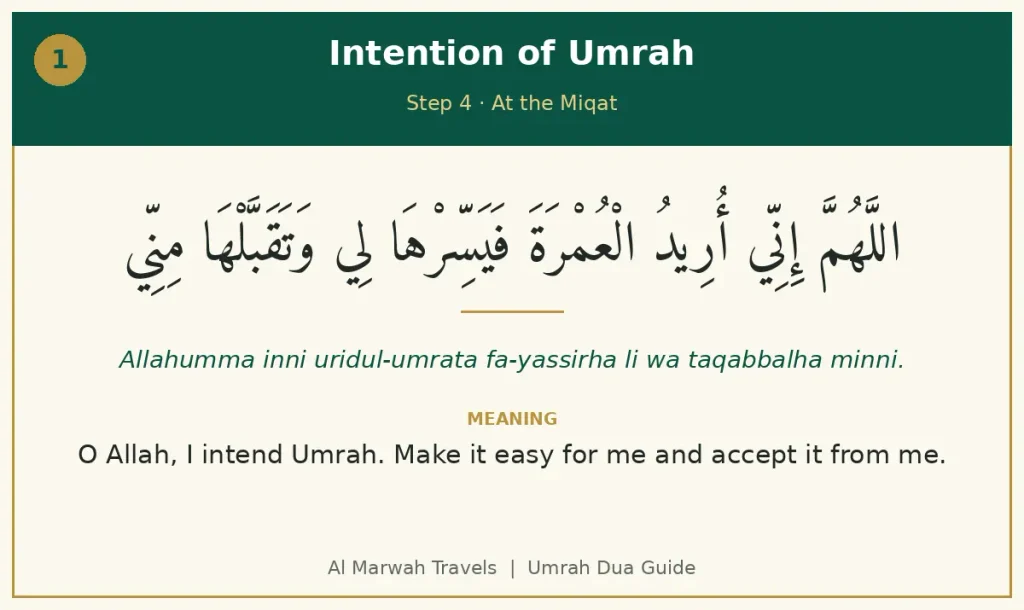
Talbiyah:
- Recite it at least once. Three times is preferable. Ihram begins when intention and Talbiyah come together.
- Men recite aloud without causing discomfort. Women recite quietly.
- Everyone recites individually, not as a group chant.
- Recite often: when climbing, descending, meeting other groups, at dawn and dusk, and after prayers.
- Stop when you first greet the Black Stone to begin Tawaf.
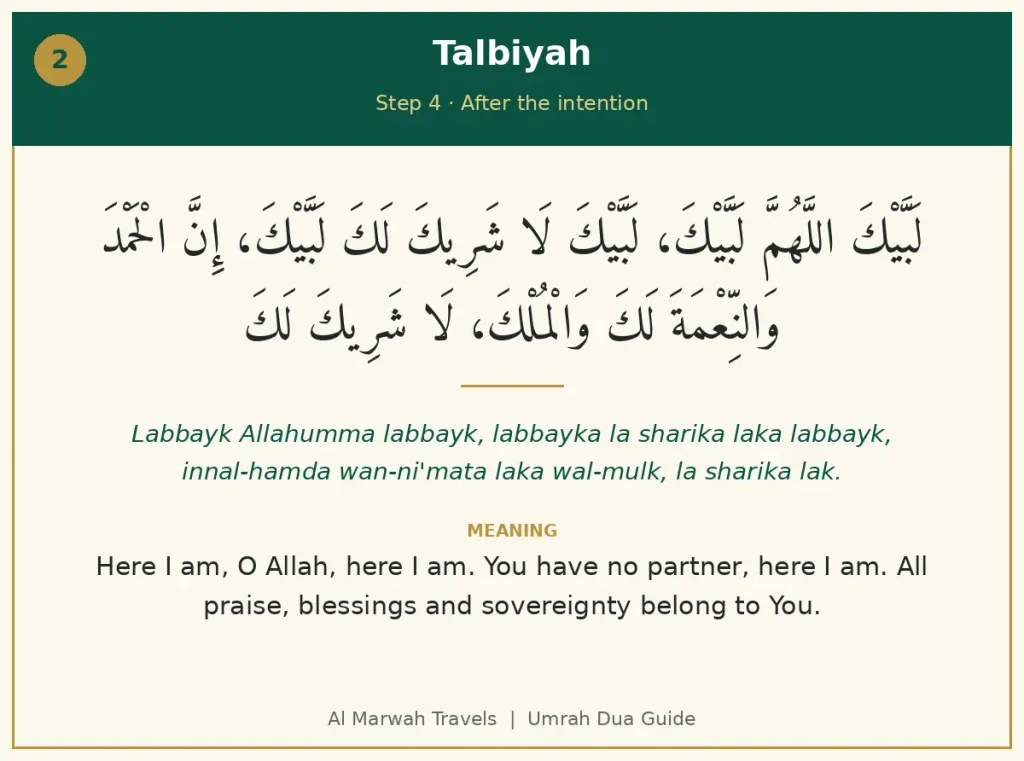
Sunnah dua after Talbiyah:
Step 5: Ihram Rules at a Glance
From the moment of intention, all of the following restrictions apply.
Haram (forbidden):
- Men: sewn clothes, head covering, gloves, and shoes or socks that cover the instep.
- Perfume on the body, clothes or hair, and eating pure fragrance such as saffron or clove.
- Intimacy, or anything that leads to it.
- Cutting nails or hair, and dyeing with henna.
- Oiling the hair or body.
- Killing lice, hunting, arguing and every sin.
Makruh (disliked):
- Combing hair, or scratching so hair falls out.
- Deliberately smelling perfume, and make-up.
- Covering the nose or face, soap-washing and tying knots in the sheets.
Permitted:
- Miswak, odourless kohl, washing clothes (not to kill lice), umbrellas, shade and pillows.
- Open sandals and flip-flops.
- One silver ring for men (under about 4.37 g, with one stone).
- Bandages on the body (not on the head or face), and killing harmful pests.
Warning: Mistakes made in Ihram bring no sin, but a penalty (dam or sadaqah) may still be due. Ask a scholar.
Step 6: Enter Makkah
- Enter the Haram limits with lowered eyes and humility, reciting salawat and Talbiyah.
- When Makkah first comes into view, say:
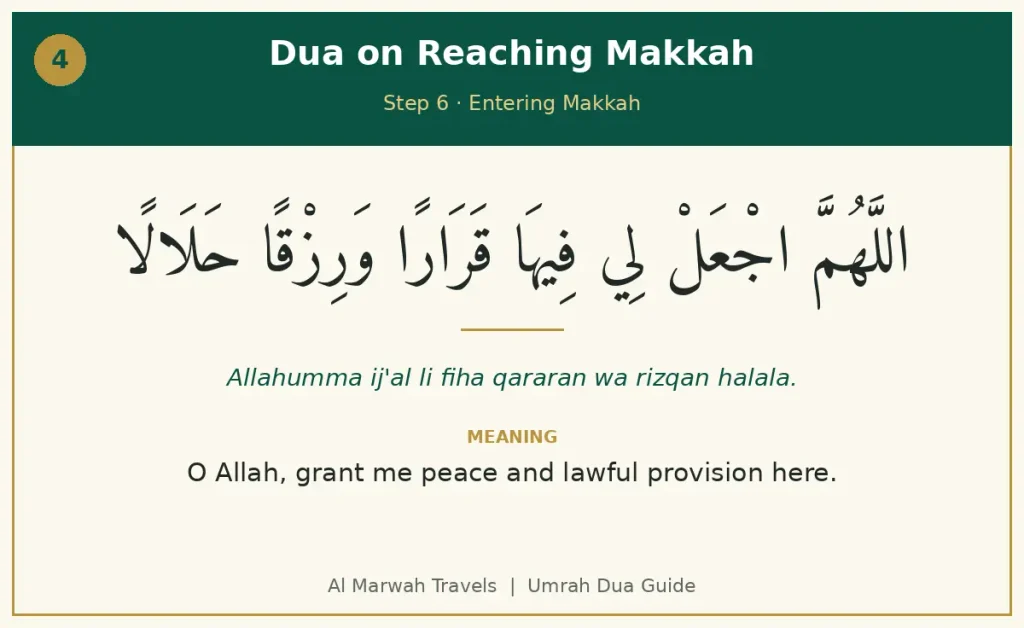
- Settle your luggage, then head to Bab-us-Salam.
Step 7: Enter Masjid al-Haram
- Enter with your right foot first and recite:
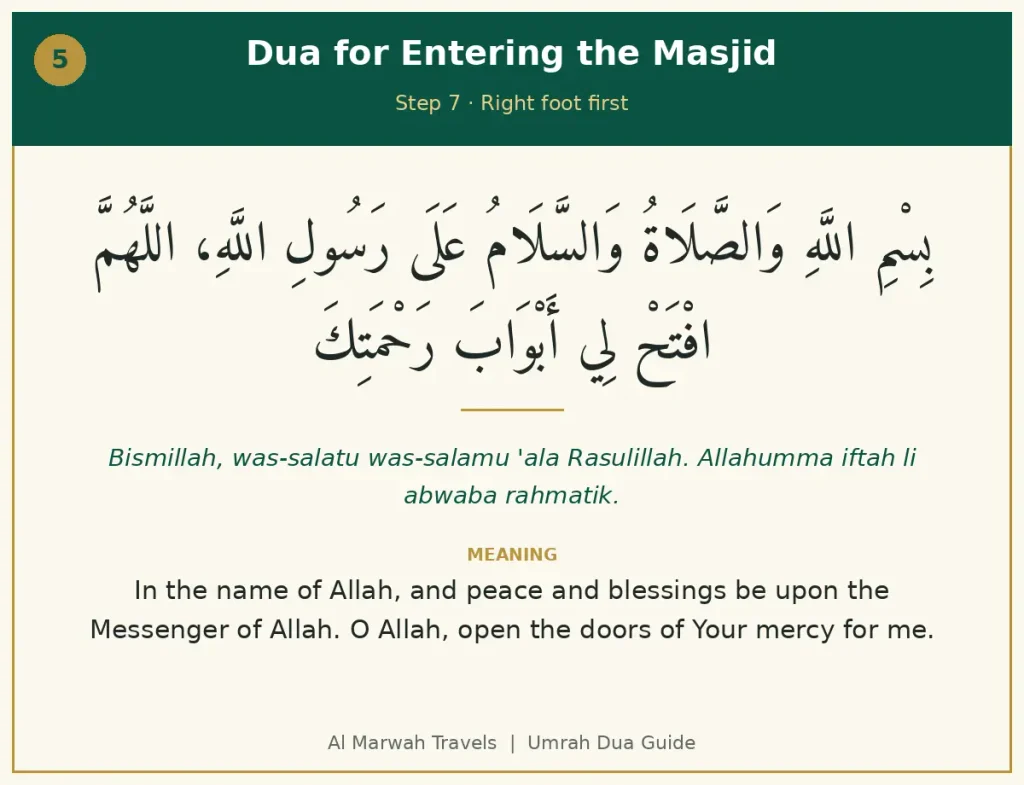
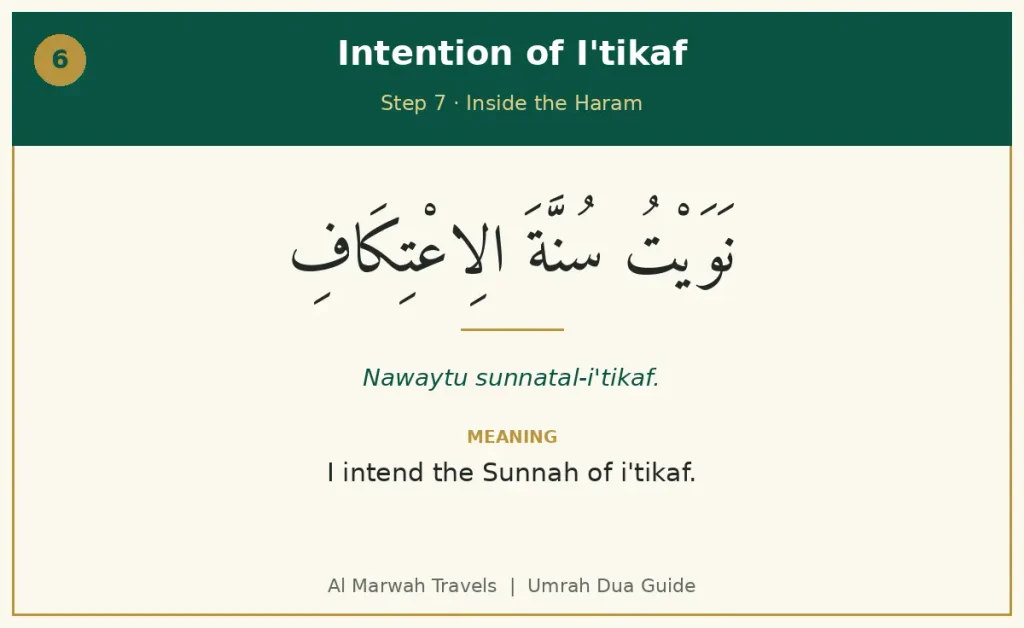
- Make the intention of i’tikaf, which also makes eating and drinking Zamzam inside the mosque permissible:
Tip: Note your entry gate number, because the Haram is huge.
Step 8: First Sight of the Kaaba
- Say Allahu Akbar and La ilaha illallah three times, then send salawat on the Prophet ﷺ.
- Make a heartfelt dua in any language, as this is a moment when dua is hoped to be accepted.
- A dua reported from the early Muslims:
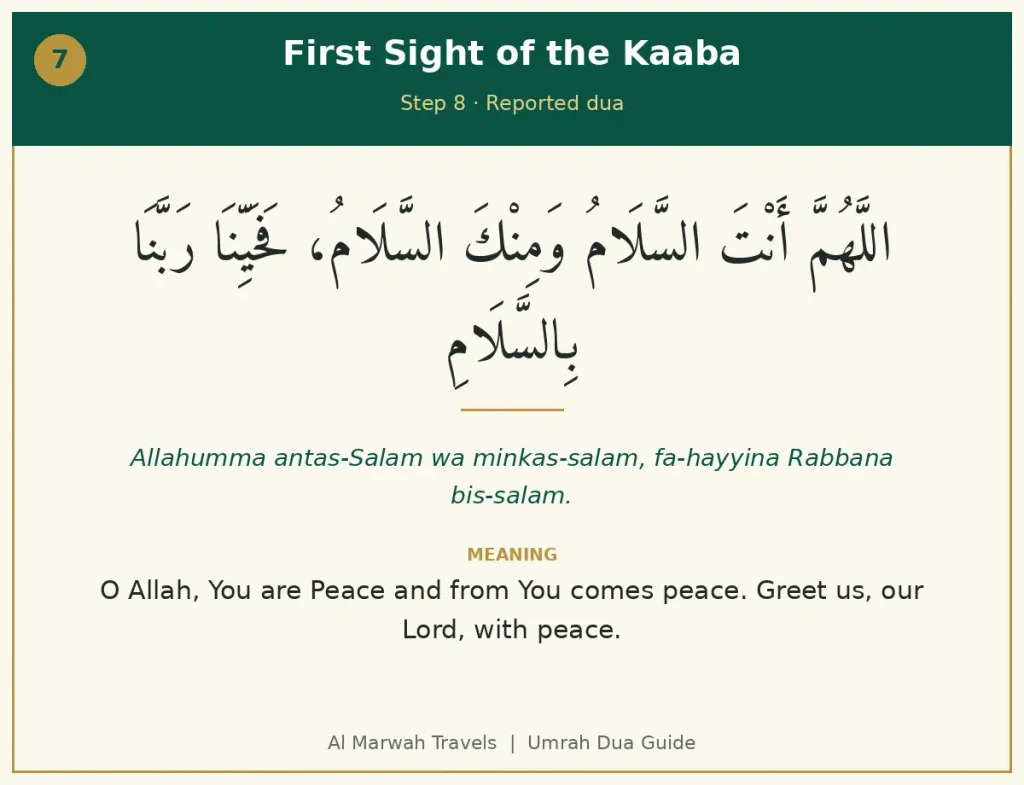
Tip: Stand to the side so you do not block walkways. Salawat is the best dua during Tawaf and Sa’i.
Step 9: Istilam, Greeting the Black Stone
What to do:
- Stand in line with the Black Stone, at the corner marked by the green light.
- Men uncover the right shoulder (idtiba).
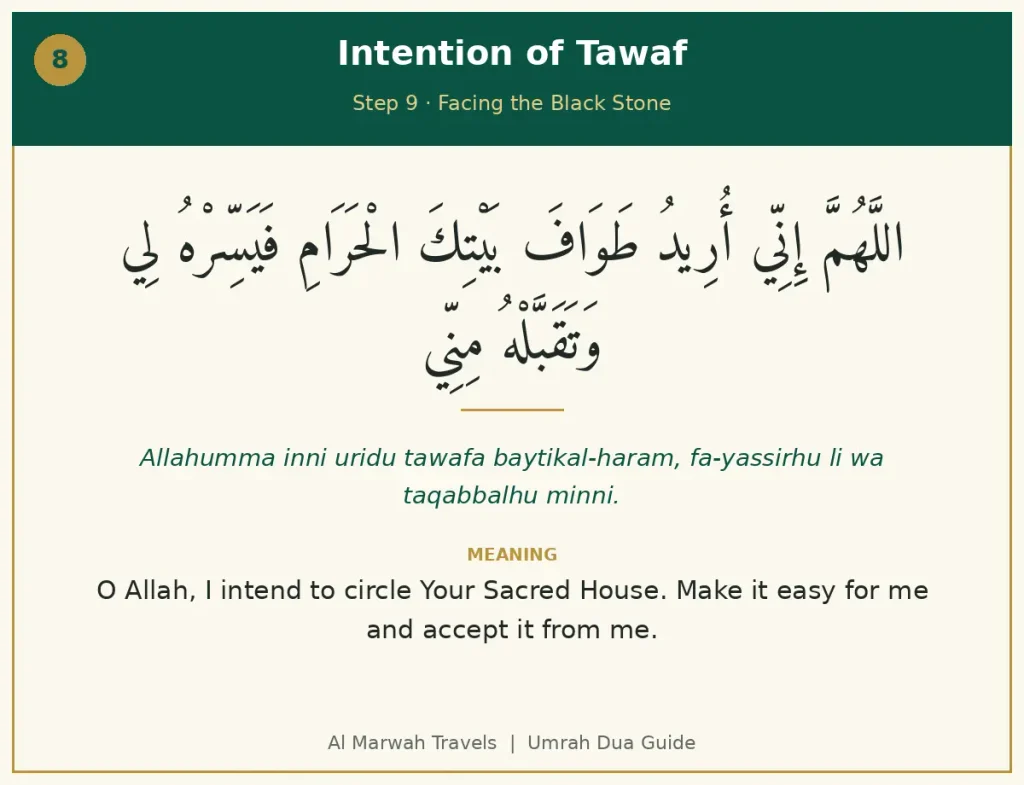
- Make the intention of Tawaf:
What is Istilam how to do?
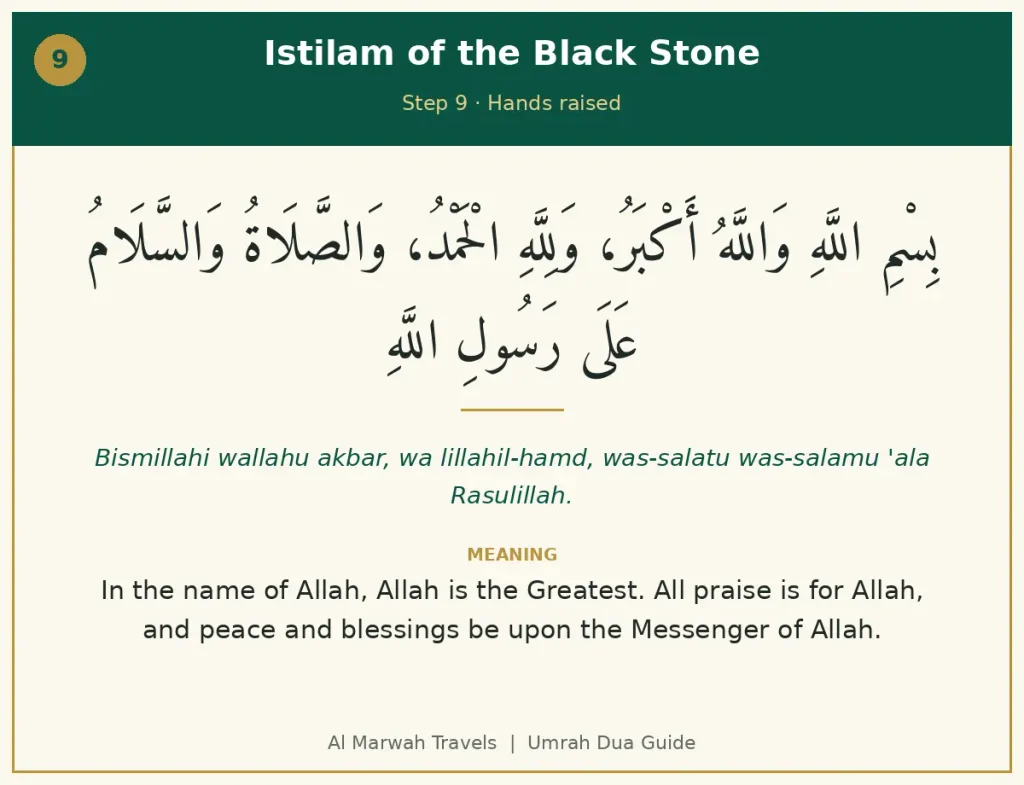
- Istilaam is sunnah do Raise both hands to ear level, with palms facing the Black Stone, and say:
📷 IMAGE: 09-istilam-of-the-black-stone.png
Alt: Istilam dua for the Black Stone in Arabic with transliteration and English meaning
Caption: Bismillahi wallahu akbar, wa lillahil-hamd, was-salatu was-salamu ‘ala Rasulillah.
- Lower your hands and kiss your palms. Kiss the stone itself only if it is easy and safe.
- If it is crowded, do not push. Raising your hands from a distance is fully valid.
Tip: Repeat the Istilam as you pass the Black Stone line at the start of each new round. Women should avoid the crowd.
Step 10: Tawaf (Seven Rounds)
Rules:
- Walk anticlockwise with the Kaaba on your left.
- Hatim is included in the circuit.
- Men walk briskly (ramal) in the first three rounds and normally in the rest.
- Recite quietly while walking. Do not stop in the flow to make dua, because it blocks others.
- Make Tawaf with wudu. Women who are menstruating should wait until they are pure.
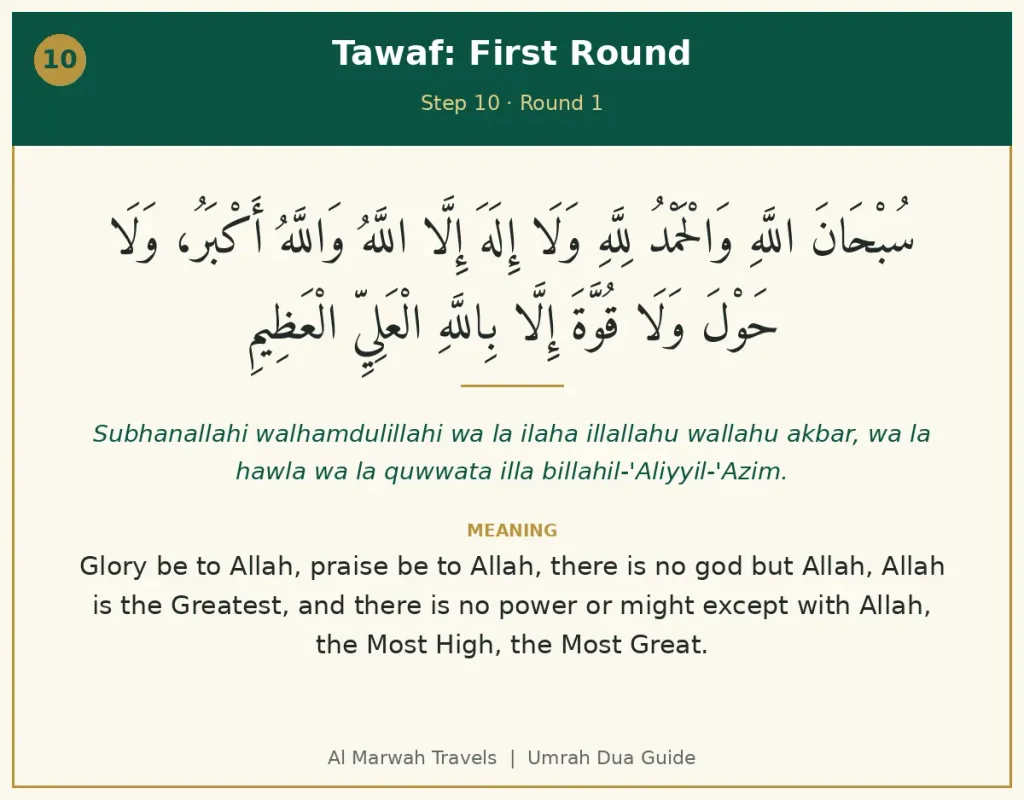
First Round Dua
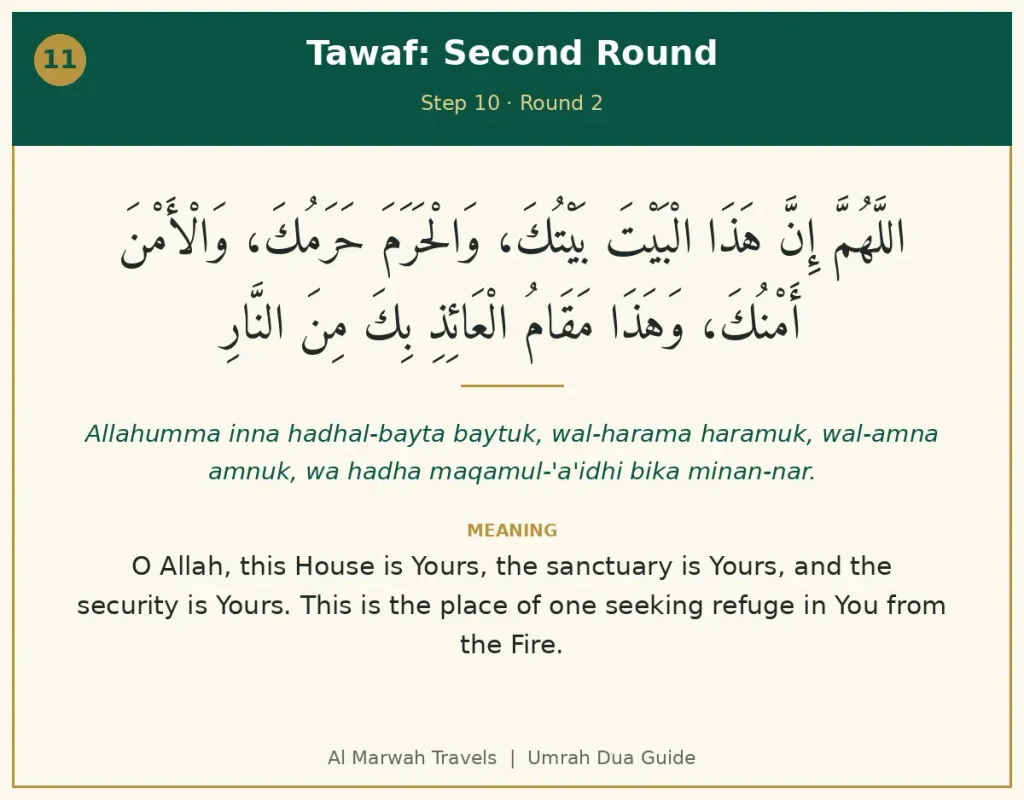
Second Round Dua
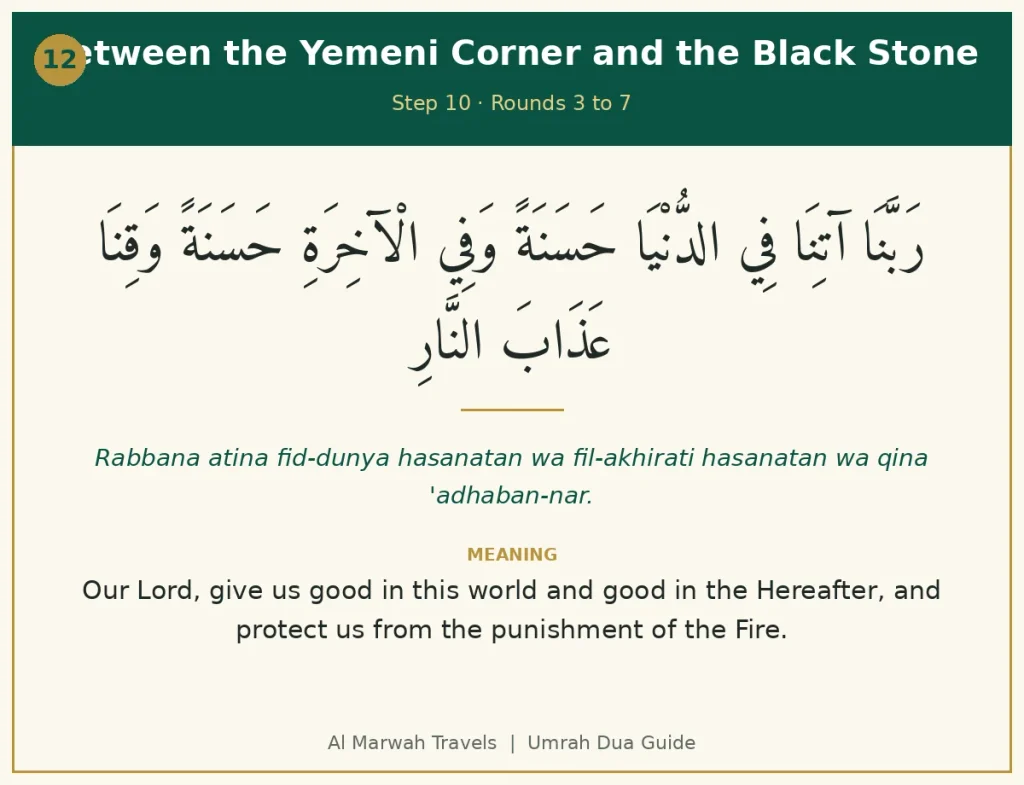
Rounds 3 to 7
Between the Yemeni Corner and the Black Stone, recite:
Fill the remaining time with salawat and personal dua in any language.
Step 11: Maqam Ibrahim and Two Rakahs
- Cover your shoulders again (men).
- After the seventh round, pray two rakahs behind Maqam Ibrahim, or anywhere in the Haram if it is crowded. These are wajib, not optional.
- Avoid makruh times. Recite al-Kafirun in the first rakah and al-Ikhlas in the second.
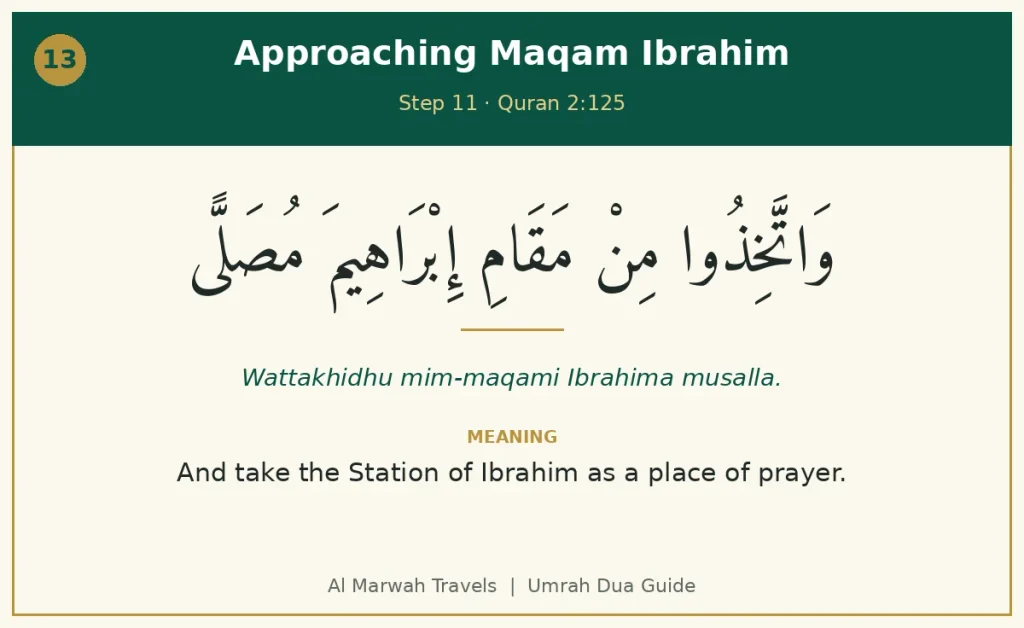
- On approaching the Maqam, recite:
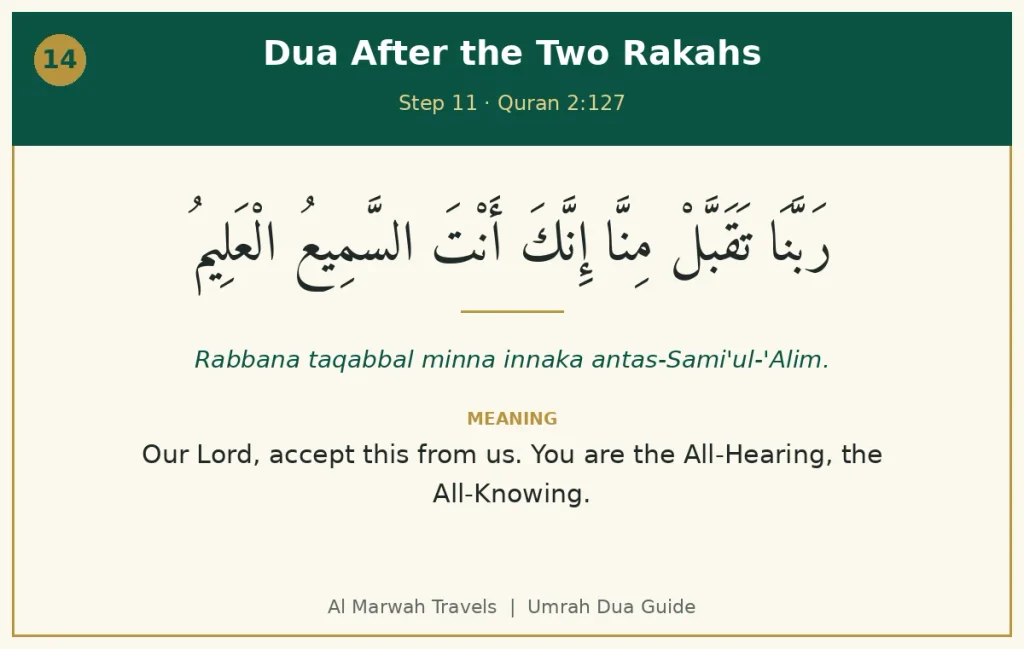
- After the prayer, make this dua:
- If possible, greet the Black Stone once more before heading to Safa.
Tip: Do not push for a spot near the Maqam. The prayer is valid anywhere in the Haram.
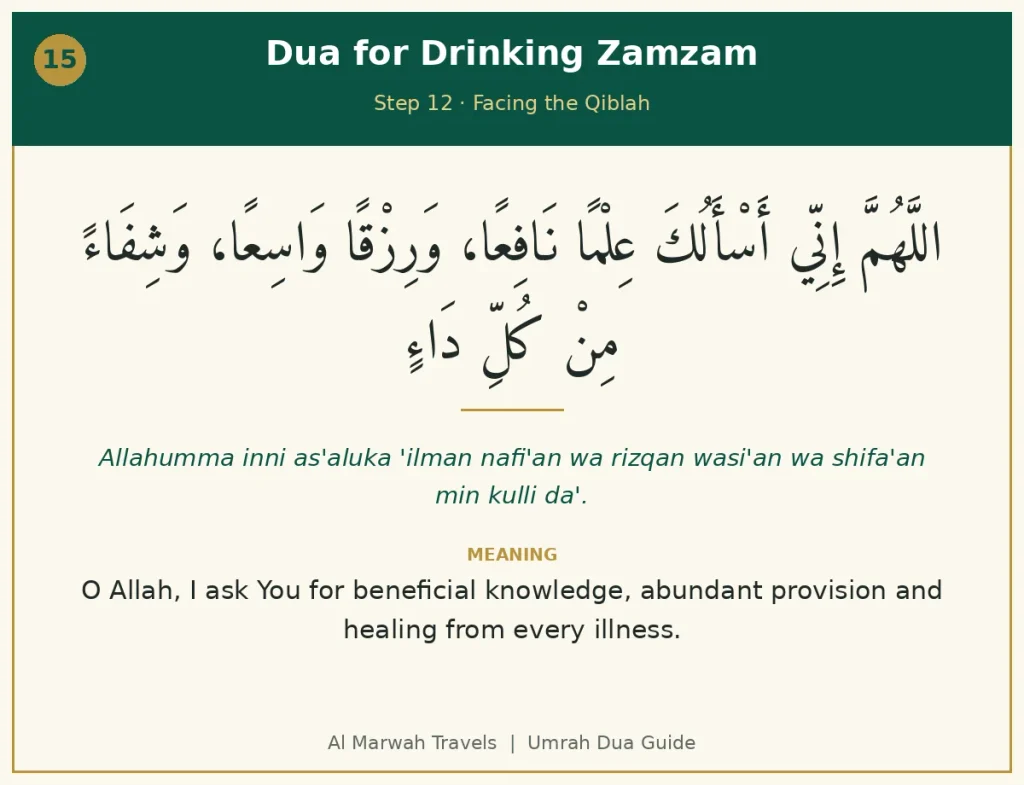
Step 12: Drink Zamzam
- Face the Qiblah, drink in comfortable sips and make dua.
Step 13: Sa’i Between Safa and Marwa
What to do:
- Start at Safa and finish at Marwa after seven trips (Safa to Marwa counts as one).
- At Safa, face the Kaaba and recite:
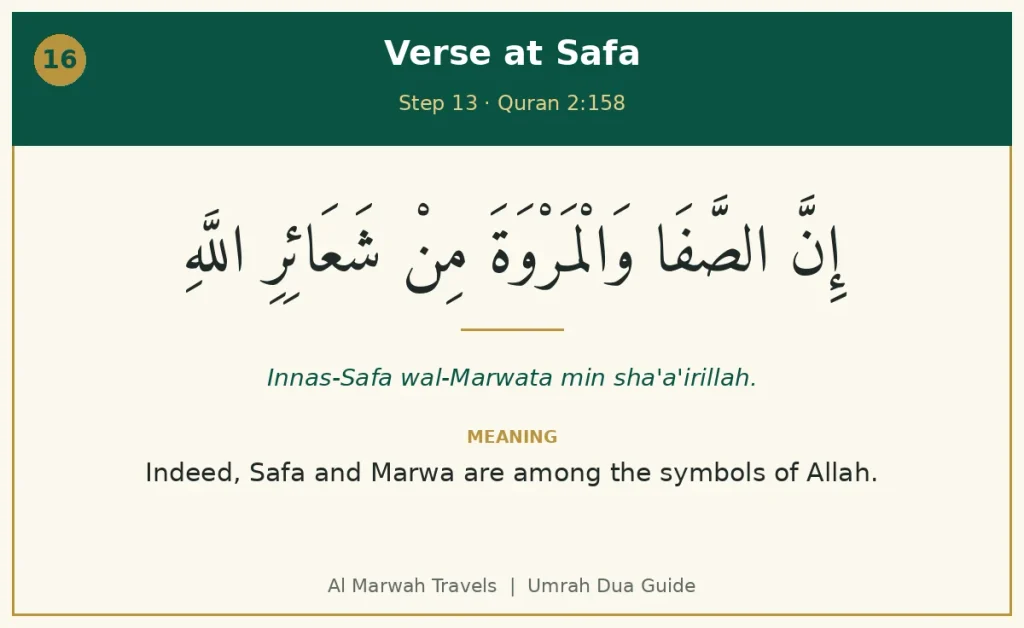
- Say Allahu Akbar three times, then:
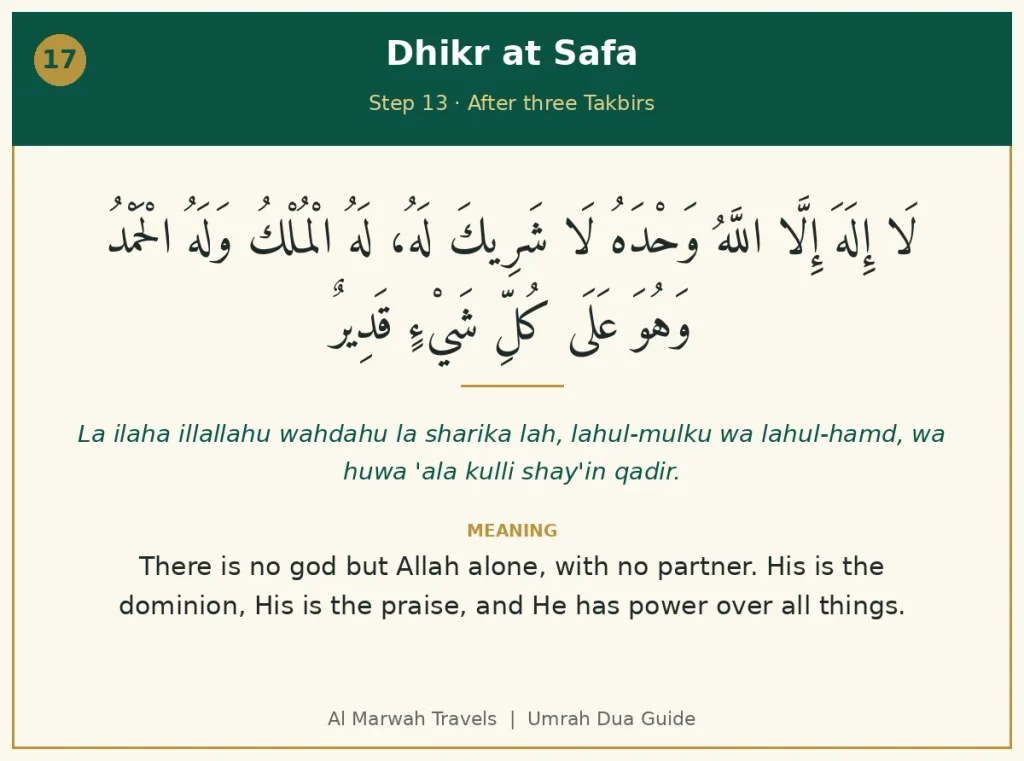
- Make a personal dua, then walk to Marwa and repeat there.
- Men jog lightly between the two green markers. Women walk normally.
Tip: Wheelchairs and buggies are available for those who need them. Ask the Al Marwah Travel team before you travel.
Step 14: Halq or Taqsir
- Men shave the head (preferred) or trim the hair evenly.
- Women trim about a fingertip’s length from the ends of their hair.
- Your Ihram restrictions now end and your Umrah is complete.
- Use a licensed barber near the Haram and agree the price first.
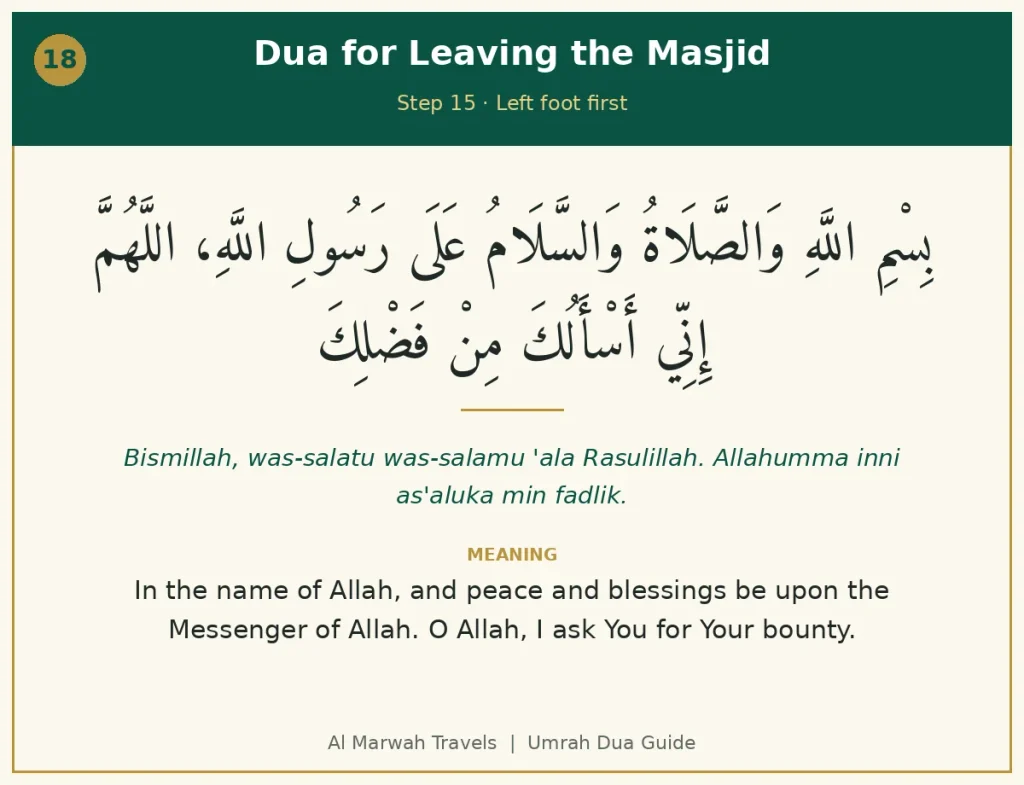
Step 15: Your Umrah is complete then Leave the Mosque
- Step out with your left foot and say:
Sunnahs of Umrah Must Remember
- Idtiba: Men uncover the right shoulder during Tawaf.
- Ramal: Men walk briskly in the first three rounds of Tawaf.
- Jogging in Sa’i: Men jog lightly between the two green markers when going between Safa and Marwa.
- Istilam: Greet or kiss the Black Stone at the start of each round.
- Talbiyah: Recite it often from the moment of intention until Tawaf begins.
Explore Cheap Umrah packages for UK pilgrims with Al Marwah Travel
Al Marwah Travel handles flights, hotels, vaccine guidance and visa processing in one place. Explore new customised, cheap Umrah packages today. For Umrah vaccine information or visa help, chat with Al Marwah Travel now.
May Allah accept your Umrah, forgive your sins and make your journey easy. Ameen.
Scholar-Referenced Guide
This guide is compiled from trusted Islamic sources, including books published by Maktaba-tul-Madinah (Dawat-e-Islami) such as Rafiq-ul-Haramain, along with authentic Hadith collections. The rulings follow the Fiqah e Hanafi.
Reviewed by: Zeeshan Ahmed
Rulings can differ slightly between scholars and schools of thought. If you are unsure about anything, ask a qualified scholar before you travel.
Frequently Asked Questions
What are the 7 steps of Umrah?
Put on Ihram before the Miqat.
Make the Niyyah (intention).
Recite the Talbiyah.
Perform Tawaf (seven rounds around the Kaaba).
Pray two rakahs at Maqam Ibrahim.
Perform Sa’i (seven trips between Safa and Marwa).
Do halq or taqsir (shave or trim the hair).
How long does a full Umrah take?
The rituals usually take 3 to 6 hours, depending on how crowded it is. Most UK packages last 7 to 14 days so there’s time to visit Madinah as well.
Can I wear undergarments with Ihram?
Men can’t wear undergarments, or any sewn clothing, once they’ve made the intention. They can wear them before the intention, while getting ready. Women can wear their normal undergarments.
Can I put perfume on my body after wearing Ihram?
You can apply perfume before the intention, and that is Sunnah. Once you’ve made the intention, perfume is forbidden on your body, Ihram sheets or hair.
What if perfume touches me by mistake during Ihram?
Remove it straight away. If it covers a full limb or a large part of the body, a dam becomes due. If it’s less than that, sadaqah is due.
What does “dam is wajib” mean?
Dam is a penalty for breaking certain Ihram rules. It means sacrificing one goat or sheep, or a one-seventh share of a cow or camel, and the meat is given to the poor.
Does the dam animal have to be sacrificed within the Haram boundaries?
Yes. The dam animal must be slaughtered within the Haram limits of Makkah. The pilgrim who owes the penalty can’t eat its meat. Licensed services can arrange it for you
What slippers should men wear for Umrah? Is it mandatory?
Yes. Men’s footwear must leave the raised middle part of the foot (the instep) uncovered. Cross-strap slippers or flip-flops work well. Closed shoes and trainers aren’t allowed after the intention.
What precautions should I take on the plane after wearing Ihram?
Don’t use perfumed tissues, wet wipes or scented hand wash in the plane toilet.
Don’t let any cloth, mask or blanket touch the face, for both men and women.
Men should keep their feet uncovered on top and shouldn’t use the airline socks.
Women should keep their hair properly covered.
Avoid music, films and idle talk, and keep reciting the Talbiyah.
Is it mandatory to visit Madinah during Umrah?
No. Visiting Madinah isn’t part of Umrah, but it is highly recommended so you can visit Masjid an-Nabawi and send salam to the Prophet ﷺ.
Can a woman do Umrah by herself?
Saudi law now allows women to travel for Umrah without a mahram as part of an organised group. In the Hanafi school, though, a woman should not make a journey of this distance without a mahram, so ask a scholar before booking.
How do I use the toilet while in Ihram?
You can use the toilet as normal. Wash with water only and avoid scented soap, perfumed wipes and scented tissues. Hold your Ihram sheets up so they stay clean.
Is it mandatory to visit all the ziyarat places?
No. Ziyarat visits are rewarding, but they aren’t part of Umrah, and your Umrah is complete without them.
How do I use the toilet while in Ihram?
You can use the toilet as normal. Wash with water only and avoid scented soap, perfumed wipes and scented tissues. Hold your Ihram sheets up so they stay clean.
Is Umrah easier than Hajj?
Yes. Umrah has fewer rituals, can be done at any time of year and takes only a few hours. Hajj takes about five days on fixed dates and is fard once in a lifetime for those who can afford it.